Our Work

Project Case Studies

Real projects, walked through step by step — from the first site assessment to final sign-off.

How a RHO project unfolds

Each case study below walks through the same six-step methodology we apply to every project — from site assessment through documentation and sign-off.

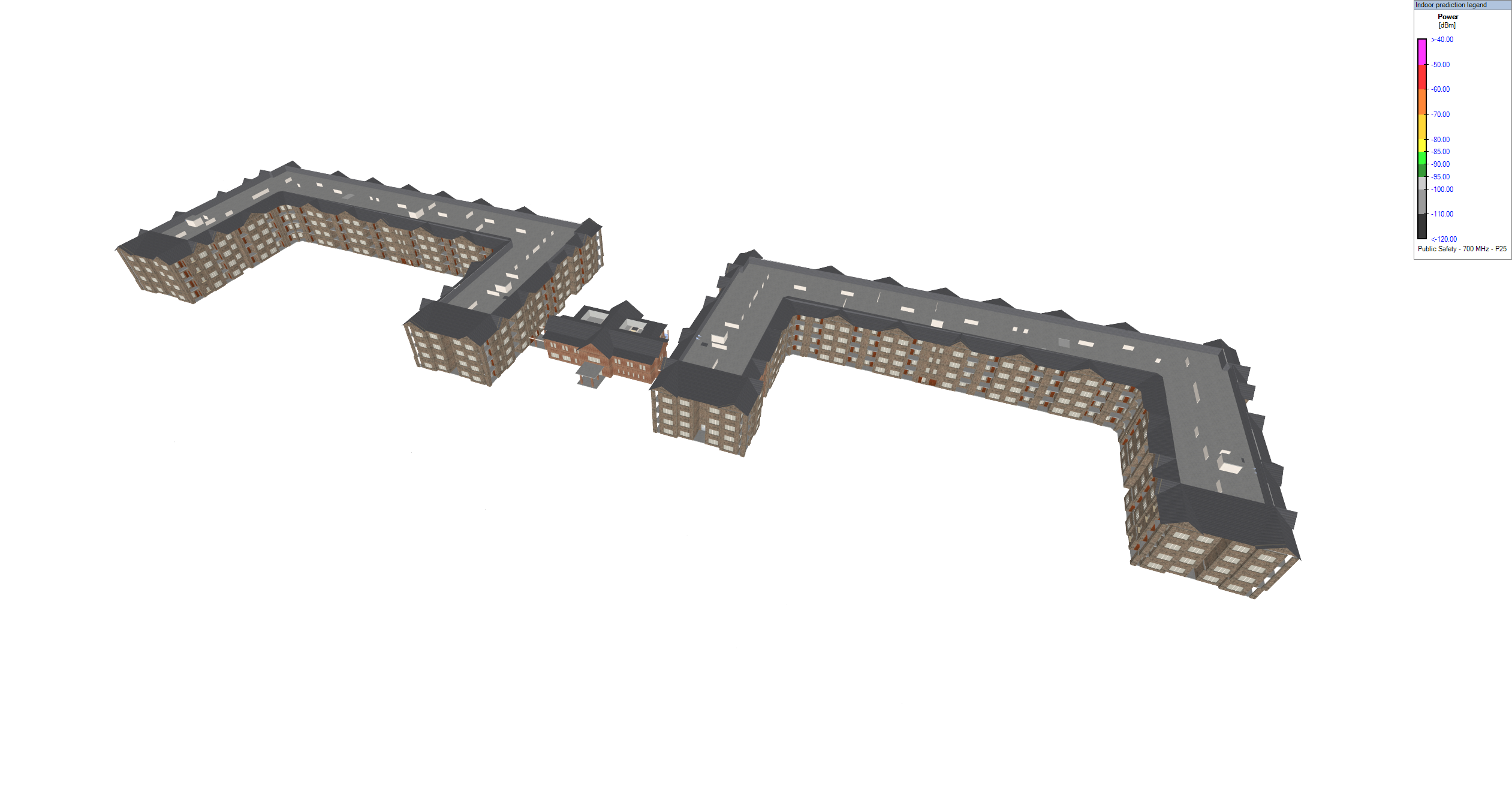
iBwave 3D model of the three-building apartment complex used for signal strength predictions
iBwave 3D image of the apartment complex.
Three-Building Apartment ComplexDallas, Texas

Case Study One — ERCES Requirement Determination

A three-building apartment complex in Dallas needed a determination of whether an Emergency Responder Communication Enhancement System (ERCES) was required under the city's fire code.

Outcome

The initial site assessment indicated that an ERCES might be required, but a definitive determination would require verification testing after the buildings were substantially complete. The verification grid tests showed that an ERCES was not required for any of the buildings.

How This Project Unfolded

Site Assessment

Building construction, floor plans, and the AHJ coverage requirements were reviewed. The City of Dallas adopted the 2021 edition of the International Fire Code in January of 2023. The buildings were modeled in iBwave so that first-floor signal strength predictions could be completed as part of the baseline RF survey.

Additional detail

Baseline RF Survey

First-floor signal strength predictions were completed for all three buildings, and the decision was made to proceed with the ERCES design and obtain a permit to allow conduit installation. Once the exterior walls were constructed and roof access was possible, SeeHawk Touch and the IBflex were used to measure the existing signal environment.

Additional detail

System Design

The system design was completed and a 3D model built in iBwave, with antenna placement and equipment iterated until simulated coverage met the requirements. The plans were submitted to the City of Dallas for review and issuance of the ERCES building permit.

Additional detail

Installation Support

Conduit drawings were provided to the general contractor for the conduit, access panel, and roof weatherhead installation. Technical oversight during installation kept the build to specification and flagged deviations early.

Additional detail

Verification Testing

A full walk test and Public Safety Grid Test in accordance with IFC 510 were completed and compared against design targets. The required documentation was prepared for submittal to the Fire Marshal's office.

Additional detail

Documentation & Sign-Off

The Radio Coverage Signal Strength Assessment package was submitted to the Fire Marshal's office, indicating that an ERCES was not required.

Additional detail
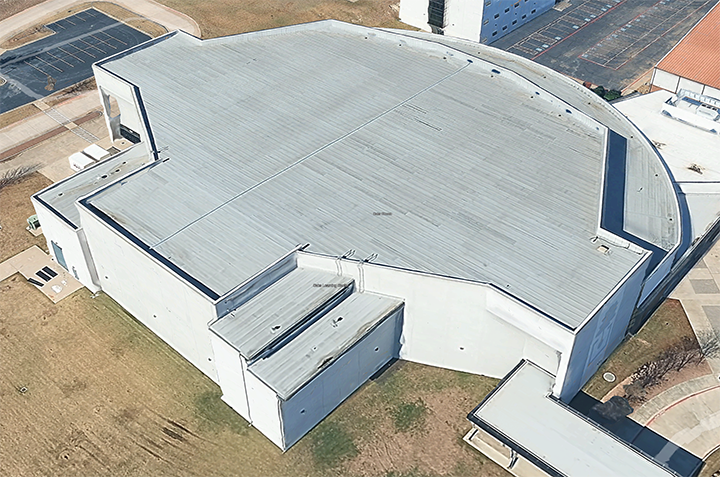
Aerial Google Earth view of the church with its large white roof
Google Earth image of the church. You can see why the cellular signals had trouble penetrating the solid exteriorconcrete walls
Church AuditoriumRed Oak, Texas

Case Study Two — Cellular Distributed Antenna System (DAS)

We were contacted by a local church that was having problems making and receiving calls in the church's auditorium. RHO was asked to provide a cellular system so that member's could make and receive calls while in the auditorium.

Outcome

Cellular DAS coverage improved across the board. Church officials and parishioners were very pleased with the results.

How This Project Unfolded

Site Assessment

The auditorium's construction, floor plan, and coverage requirements were reviewed. The Auditorium walls were solid concrete causing significant signal loss by all carriers  The area to be covered by the cellular DAS was approximately 21,000 square feet.

Additional detail

Baseline RF Survey

We used SeeHawk Touch and IBflex for a walk test to collect the RF signal strengths for the cellular frequencies that could be  delivered by the DAS. The captured signal strengths were uploaded into iBwave for review. All of the collected signals needed to be amplified.

Additional detail

System Design

A 3D model built in iBwave, with antenna placement and equipment iterated until simulated coverage met the required signal strengths for reliable cell phone operation. A Nextivity Quatra 4000 system was recommended for installation.

Additional detail

Installation Support

Technical oversight was provided during installation to keep the build to specification and allow for any required updates to the iBwave model. The Nextivity Quatra 4000 is an all-digital, active Distributed Antenna System (DAS) hybrid designed to eliminate indoor dead zones and dropped calls.

Additional detail

Verification Testing

A full walk test and Public Safety Grid Test in accordance with IFC 510 will be completed and compared against design targets. The required documentation will be prepared for submittal to the Fire Marshal's office.

Additional detail

Documentation & Sign-Off

A documentation package was completed and made available to the customer. In this case, the customer did not require the documentation. They had their parishioners evaluate the results and they were very pleased.

Additional detail
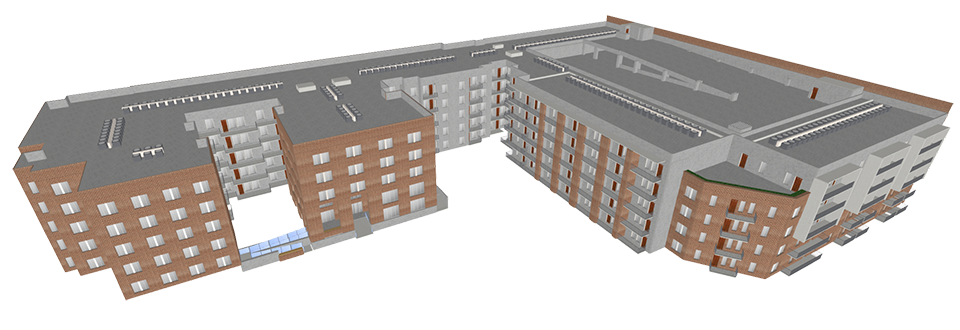
iBwave 3D architectural model of the five-story apartment building used for the ERCES coverage analysis
iBwave 3d model of the five-story apartment building
Five-Story Apartment BuildingDallas, Texas

Case Study Three — Five Story ERCES Proposal Request

A potential customer asked for am ERCES assessment and proposal for the design, installation and testing to meet the requirements by the City of Dallas's Fire Marshal.

Outcome

The initial site assessment and signal strength predictions indicate that an ERCES is required. A notional ERCES was added to the model so that a bill of materials could be created and a bid completed. The building should be pre-wired for installation.

How This Project Unfolded

Site Assessment

Building construction, floor plans, and the AHJ coverage requirements were reviewed. The City of Dallas adopted the 2021 edition of the International Fire Code in January of 2023. The building was modeled in iBwave so that first-floor signal strength predictions could be completed.

Additional detail

Baseline RF Survey

Signal strength predictions were completed for all floors and for the rooftop donor antenna location. It was determined that an ERCES will be required. When the contract is awarded and the exterior walls constructed, SeeHawk Touch and the IBflex will be used to measure the existing signal environment and verify the need for an ERCESS

Additional detail

System Design

The system design was completed and the iBwave model was updated, with placement of the DAS cables and antennas and a determination of the number of Fiber DAS system that would be required. A Comba Telecom 2-Watt CriticalPoint Public Safety Fiber DAS was proposed. Since signal strength predictions determined that an ERCES will be required, it is recommended that the building be prewired.

Additional detail

Installation Support

Technical oversight during installation to keep the build to specification and flag deviations will be provided.  Ordering of the head-end equipment will be delayed until after the need for an ERCES is confirmed by verification testing.

Additional detail

Verification Testing

A full walk test and Public Safety Grid Test in accordance with IFC 510 will be completed and compared against design targets. Testing will occur when the building is substancialey complete. The required documentation will be prepared for submittal to the Fire Marshal's office.

Additional detail

Documentation & Sign-Off

The Radio Coverage Signal Strength Assessment package will be submitted to the Fire Marshal's office, indicating that an ERCES is required unless verification testing indicates an ERCES is not required.

Additional detail
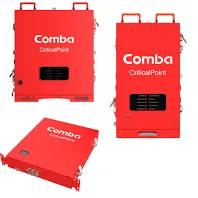
Comba CriticalPoint Public Safety Fiber DAS remote unit shown from multiple angles
Comba Telecom CriticalPoint Public Safety Fiber DAS — 2-Watt active fiber DAS.

CriticalPoint Public Safety Fiber DAS

The 2-Watt CriticalPoint Public Safety Fiber DAS that was proposed in Case Study Three is an active distributed antenna system designed to provide Emergency Radio Communication Enhancement Systems (ERCES) coverage across large buildings, campuses, and multi-story structures.

Key Specifications & Features

  • Output Power: 2 Watts (33 dBm) per band independently.
  • Frequency Bands: Available in single- or dual-band configurations covering 700 MHz, 800 MHz (Public Safety/P25 Phase I & II) bands depending on the specific model (Class A or Class B).
  • System Architecture: Comprises a Master Unit (MU) connected via single-mode fiber optic cable to Remote Units (RU). A single head-end/master setup can support up to 32 Remote Units using fiber expansion hubs.
  • Compliance: Fully compliant with NFPA, IFC, UL 2524 standards, and FCC/IC requirements; housed in rugged NEMA 4X-rated enclosures.
  • Built-in Protections: Features automated isolation tests, self-monitoring, oscillation detection with automatic shutdown/alarms, and integration with battery backup units (BBUs).

Comba Telecom CriticalPoint Public Safety Fiber DAS — 2-Watt active fiber DAS.

Have a project like these?

Tell us about your building and coverage requirements — we'll walk you through exactly how we'd approach it.